


Voice Lab
Kids Have a Say
Your generosity starts a conversation.
Voice Lab is Polyglot Theatre’s unique installation for collecting the thoughts and opinions of children. On AusArt Day (22 October), help us raise $5000 to ensure as many children as possible are being heard in their local communities.
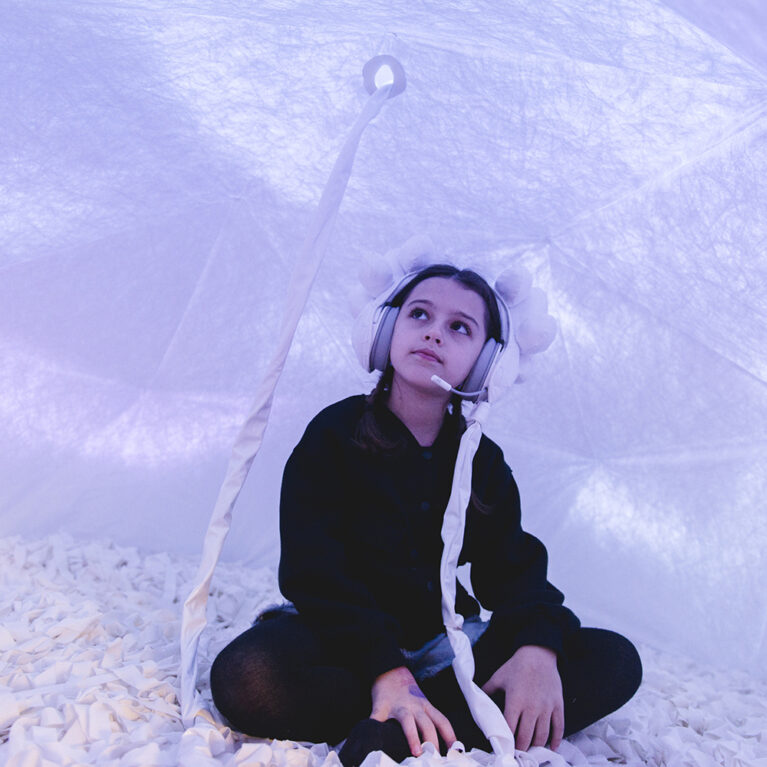

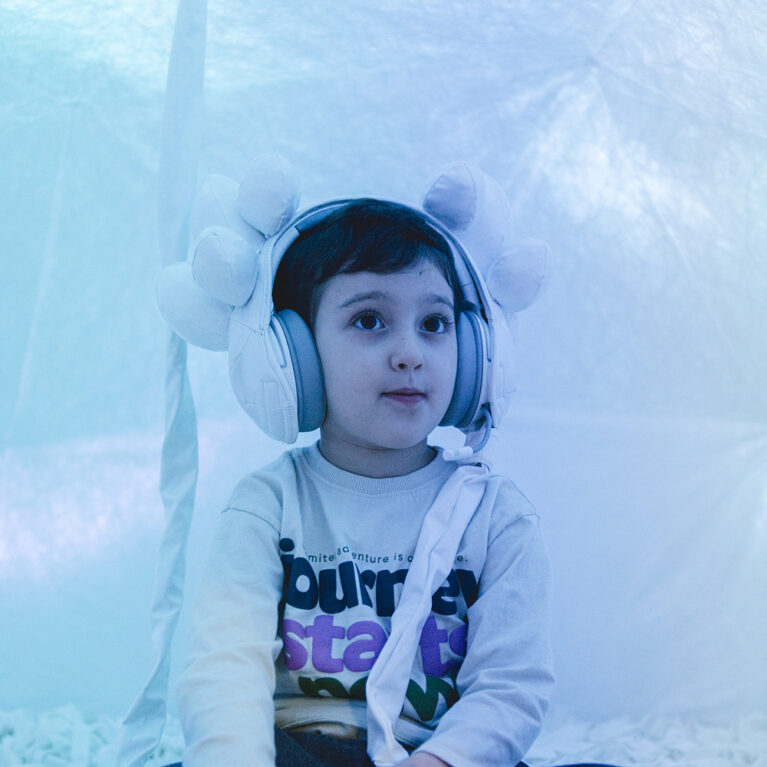
Voice Lab is an immersive, creative experience for children, one at a time, and encourages reflective thinking and the articulation of feelings.
Voice Lab embodies Polyglot’s vision to empower children. Its purpose is to listen to children’s voices and use the information they provide to make meaningful changes that can improve their lives.
Since its pilot 12 years ago in 2014, Voice Lab has had nearly 1,800 conversations with children about their lived experiences and feelings. Their insights have informed:
- Local government policy and infrastructure
- Services and programs for children and young people, including young carers, and those who have a family member living with mental health challenges
- Support for students transitioning to primary and high school
Voice Lab is highly sophisticated and currently requires specialised knowledge. With your support, we can streamline how it works with technical and design upgrades, as well as training more artists to deliver Voice Lab. Together, we can ensure as many children as possible are being heard in their local communities.
On AusArt Day (22 October), help us raise $5000 for this important work and its exponential impact.

Your generosity starts a conversation. Make art happen and donate on AusArt Day so kids have a say.
Playmakers give $2-$249; Polyglot’s Circle give $250+.
Donations of $2 or more are tax-deductible.
Give nowKids Have a Say
Share
Spread the word
Subscribe/follow
Stay up-to-date with our adventures
What is Voice Lab?
Voice Lab operates in two modes: the original physical mode and an online mode. In both, children have a one-on-one conversation with Voice Lab – a voice driven by a concealed live performer that asks questions, encourages opinion and regards the child as the expert.
Physical Mode: Children are invited to enter a beautifully designed, serene dome. Through a small entrance, they crawl, by themselves, into a soft, comforting space filled with warm fluctuating light. On the floor, at the end of a long cord connected to the roof of the dome, is a set of headphones. Through these they hear a voice — it is Voice Lab.
Online Mode: In the online mode, Voice Lab operates over Zoom. It can be offered as an experience that children participate in from their own homes and devices, or in a centralised location, like a school or community centre.
Voice Lab conversations always begin with introductory questions to make the child feel comfortable and build rapport.
- What is your name?
- How old are you?
- What is your favourite colour?
The lighting, either in the physical dome, or on-screen, then changes to the child’s favourite colour. This ensures the child knows that Voice Lab is listening to them, and that they are in control of the conversation.
The theatrical premise of Voice Lab brings something unique to the way a child interacts; it provides a sense of ritual and focus, enabling their imagination to fly because they are removed from the everyday world. Voice Lab offers privacy, attention, time and design. It allows children agency and ability to give their own opinions without interruption, mediation or interpretation by adults or peers.
The story so far
Voice Lab was first imagined in 2013 and developed across 2014-15 (Stage 1) with over 200 children from Insight School for the Blind and Vision Impaired (Pakenham), Dinjerra Primary School (Braybrook), Victorian College for the Deaf (Melbourne), and a range of Polyglot audiences at selected performances. Voice Lab was also used as a tool by Dr. Ricci-Jane Adams in her evaluation of our extended Kids Collaboration with Annunciation Primary School in Brooklyn (2015). Stage 1 was supported with seed-funding from Gandel Philanthropy and Polyglot donors.
Stage 2 of Voice Lab development was undertaken in partnership with Anglicare Victoria’s Communities for Children (CfC) Frankston and generously supported by a major grant from Gandel Philanthropy. Spanning 2016-2018, the project, The Voices of Children on Transition, explored children’s experience of transition from prep to primary and primary to high school, informing program design and policies aimed at improving outcomes for children experiencing disadvantage in Frankston.
Voice Lab spoke to pre-school students at Banyan Fields Kindergarten and Year 5 and 6 students at Mahogany Rise Primary School, and then again six months later, when they were at Banyan Fields Primary School and Monterey Secondary College. Anglicare engaged the Monash University Faculty of Education to evaluate The Voices of Children on Transition project, looking at the impact on practices in the Secondary, Primary and Early Childhood education settings involved.
Following the The Voices of Children on Transition project, with all the substantial insights and research generated, Voice Lab was positioned formally as Polyglot’s unique evaluation tool. Across 2018-2019, partners who engaged Voice Lab included Satellite Foundation, Melbourne Fringe, the City of Port Phillip and RedRoad Consulting, the City of Greater Dandenong and Mission Australia’s Communities for Children Dandenong, The Smith Family’s Communities for Children Bankstown, the Connie Benn Centre, and the City of Melbourne.
In 2020, during the COVID-19 lockdowns, an online mode was developed. Operating over Zoom, it offered children a space where they could have their voices heard and valued while grappling with schooling from home and being apart from their friends and families. It gave children the opportunity to reflect on change and uncertainty, and to begin to process the pandemic’s impact on their sense of the world and themselves. The online mode also has the capacity to reach thousands of children who might previously have been unable to engage with Voice Lab due to geographical remoteness, or other access barriers.
In 2021, important COVID-safe changes were made to the physical dome to ensure that our partners and the children and families they work with felt safe and comfortable to engage. A lightweight pop-up inflatable space was also created, which can be easily couriered to partners using the online mode in a centralised location. Simple to set up, it has been designed to imbue the online experience with the otherworldliness and magic that the original dome offers. Children enter the pop-up space one at a time, and their conversation with Voice Lab takes place via Zoom through the laptop.
Partners who have engaged Voice Lab online include Australian Red Cross NT Communities for Children Team Leader (Palmerston & Tiwi Islands), National Arts Festival (South Africa), City of Darebin, and Carers WA.
Polyglot is proud that so many different partners have used Voice Lab to ensure that children’s voices are heard in their local communities. Both the physical and online modes are employed regularly – recent partners include QPAC’s Out of the Box Festival, Monash University and the Sandro Demaio Foundation Little Food Festival, Anglicare Victoria Communities for Children Bendigo, and Abbotsford Convent.
Currently, Voice Lab is being used as part of Polyglot’s multi-year project with the Centre for Community Child Health (CCCH) – a department of The Royal Children’s Hospital and a research group of the Murdoch Children’s Research Institute. We are exploring new ways to support children 3-12 years, particularly those under 8, to share their voices through creativity and play.
Other ways to give
You can also give via direct deposit or cheque:
- Polyglot Theatre Fund Ltd
BSB: 063 138
Account Number: 1000 1352
Please fill out a donation form to accompany all direct deposits or cheques. These can be emailed to erica@polyglot.org.au or posted to:
- Polyglot Theatre
SH1.05, Sacred Heart Building, Abbotsford Convent
1 St Heliers Street
Abbotsford VIC 3067
Questions
If you have any questions, please contact:
- Erica Heller-Wagner, Marketing & Development Manager
T: 03 9826 3301 E: erica@polyglot.org.au